
Soils are living ecosystems whose recovery is integral to ecosystem restoration. Soil organisms and plant roots interact with soil structure, water and nutrients to support decomposition, nutrient cycling, plant establishment and resilience. Intact topsoils contain seeds of many of the native species in a vegetation community including soil microorganisms and soil fauna and can play a role in restoration.
Soil degradation can result from contamination, altered nutrients, hydrological change and compaction.
Re-establishing vegetation does not necessarily restore soil biodiversity or its functions. so below ground recovery should be explicitly considered in restoration planning, interventions and monitoring.
The four approaches outlined in the National Standards for the practice of Ecological Restoration in Australia apply to soils in the same way they apply to other elements of restoration sites.
Examples and resources
1. Current knowledge on soil microbiota to improve ecosystem restoration
https://onlinelibrary.wiley.com/doi/10.1111/brv.13124
2. Keep it together: testing soil core translocation
https://besjournals.onlinelibrary.wiley.com/doi/10.1111/1365-2664.70474
3. Restoring soil biodiversity study
https://www.cell.com/current-biology/fulltext/S0960-9822(24)00177-5?_returnURL=https%3A%2F%2Flinkinghub.elsevier.com%2Fretrieve%2Fpii%2FS0960982224001775%3Fshowall%3Dtrue
4. Example of soil translocation to improve drought resilience in a keystone grass
https://www.authorea.com/doi/full/10.22541/au.173340921.11475885/v1
5. Study of soil microbial inoculation on performance of Wallaby Grass in South Australia
https://aff.org.au/wp-content/uploads/FF_report_Guevara_D.pdf
6. Three topsoil translocation case studies for restoring plant diversity (video – view from timestamp of 6.30)
https://www.aabr.org.au/portfolio-items/topsoil-translocation-25-years-whats-been-learnt/
7. Tasman Highway rehabilitation project (video)
https://www.youtube.com/watch?v=eUfzHKzMgFk
Recommended actions for restoration site assessment, treatment prescription, implementation and monitoring:
- Assess degradation drivers. Compare soil conditions and biodiversity with appropriate reference ecosystems, identifying causes of degradation such as compaction, altered nutrient levels, contamination and loss of soil organisms.
- Assess recovery potential. Consider potential to restore suitable physical and chemical conditions and support natural recovery through appropriate vegetation, litter inputs and disturbance management, as well as any likely depletion of soil microbes.
- Consider targeted reintroductions where justified. Where biological recovery remains constrained, trial ecologically appropriate soil or microbial inoculations through e.g., translocation of intact topsoil plugs (while protecting donor ecosystems and avoiding transferring unwanted species such as novel pathogens).
- Consider translocating soil microbiomes on a trial basis to increase climate-readiness. Soil microorganisms influence nutrient acquisition, plant–soil feedback and tolerance of environmental stress. Their provenance may therefore affect how restoration plantings respond to future climates.
- Monitor biodiversity and function. Maintain good records of interventions and assess changes over time through indicators such as such as evidence of decomposition and nutrient cycling, and plant responses; and consider partnering with researchers to track accompanying changes in soil biodiversity recovery.
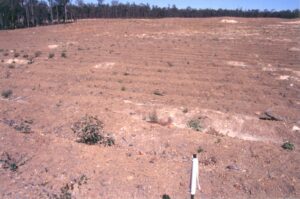
ABOVE: Replaced topsoil – at 0 years. Jarrahdale, Alcoa minesite restoration.
Photos credit – Carl Grant and John Koch
 ABOVE: Replaced topsoil – at 2 years. Jarrahdale, Alcoa minesite restoration.
Photos credit – Carl Grant and John Koch