 SER Western Canada of the Society for Ecological Restoration

Publications
The SER-WC Annual General Meeting and Fall Forum in Saskatoon, Saskatchewan, featured a range of useful presentations — some focused on local restoration efforts and best practices, and others highlighting important ecological processes that have implications for restoration.
SER-WC Director Darcy Henderson, a senior species at risk biologist with Environment and Climate Change Canada, kicked off the event with a presentation that provided context through a much broader perspective.
Titled Recipes for Restoration: Context of Climate and Landscape in Western Canada, the presentation made it clear that restoration strategies must consider local landscapes and climate conditions.
Henderson puts it this way in his presentation abstract:
If you have lived in wet and dry parts of Western Canada, and you happen to be a baker, you may have noticed how the same recipe doesn’t always work in one place or the other. I certainly notice that a lot of recipes in dry places require you to add a quarter cup of water not otherwise called for, because the recipe-book author lived in a wet place where their flour, baking soda, and other ingredients had absorbed moisture from the air while mine had desiccated.
In a restoration context you see the same things. Season and method of planting, along with the use of cover crops are particular pet peeves of mine. We have drastically different ecosystems across Western Canada, from Pacific Maritime Rainforest, to Great Basin Deserts, to Northern Great Plains, to Subarctic and Subalpine Coniferous Forests, to Alpine and Arctic Tundra. We also have very different landscape contexts.
A restoration site in the middle of an agricultural and urban landscape is going to suffer from an abundance of weeds and propagule pressure with no native plant and soil micro-organism immigration over time. In contrast, a mine site, right of way, or well-pad in large expanses of natural forests and grasslands are surrounded by an abundance of natural propagule sources and dispersal vectors.
Despite these challenges and opportunities, we often see the same poor practices of hydro-seeding cover crops and cultivars of the same agricultural species without respect to climate and landscape. Let’s talk about it and challenge some norms. Good bakers must know how to substitute and supplement ingredients when necessary.
A new issue of Restoration Ecology is now available, and it’s full of in-depth information and ideas. Click here to view the full issue.
Looking to contribute to Restoration Ecology?
Guest editors for an upcoming special issue on “Forest Landscape Restoration in the Context of Cumulative Effects” have sent out a Call for Papers.
If you’re interested, you’ll find all relevant details within the link above, including contact information, maximum length and specifics on focus and scope.
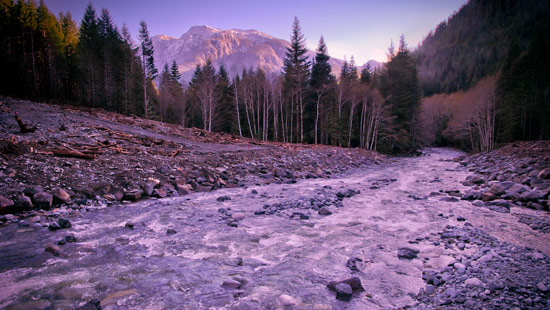 By 2012, the Heber Dam near Gold River, BC, had finally reached the end of its useful life after damming up the Heber River since 1953.
Before removing the dam and its associated contaminated materials, BC Hydro wanted to devise a plan to bring the Heber River back to its natural flow and conditions, while restoring the stream bank and surrounding area using natural processes as a model for recovery.
SER-WC Board member David Polster, a restoration ecologist for Polster Environmental Services Ltd., was called upon to develop the restoration plan, which he documented in a new research paper that provides in-depth descriptions and visual depictions of the regeneration process as it unfolded.
A key step in any restoration process, writes Polster in the report, is to identify the “filters” that prevent ecological recovery, such as soil compaction or erosion, and then consider ways of rectifying those filters. It’s also important, he adds, to identify functioning local ecosystems as models for reference.
After assessing the disturbed area around the dam, Polster decided to employ a “rough and loose” technique, which entails creating an array of mounds and holes covered up by woody debris to limit erosion and provide multiple sites for seed capture and growth.
The method offers a diversity of micro-sites for different species to get established—from dry areas at the tops of mounds to moist areas in the depressions—and closely mimics the regeneration process of a recovering forest ecosystem after natural disturbances, such as forest blow-down or fires.

In 2012, the project site was made “rough and loose” by creating mounds and depressions under a bed of woody debris, setting the stage for ecological recovery by increasing diversity of micro-sites.
By 2013, alders and other pioneer species had begun to green up the banks of the Heber River, and a local First Nations crew was hired to transplant sword ferns from the surrounding forest. Establishing alders on disturbed sites early in the process was very important, since they provide a deciduous cover to ensure that conifers grow well underneath.
The fast-growing alders provide shade during hot summers, transpiring moisture to create a cool, moist micro-environment, and in winter, they shed their leaves to offer more sunlight for conifers growing below. Transplanting the roughly 1,000 sword ferns was also very important, since they brought in other soil micro-organisms, which are essential to the development of a fully functional forest.
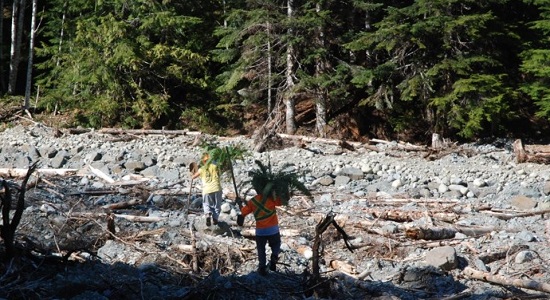
Members of the local Mowachaht/Muchalaht First Nation helped in the restoration work by transplanting sword ferns from adjacent forested areas.
In his report, Polster points out not just the ecological benefits of restoring the Heber river—an important west coast salmonid river—but also the cost savings of using natural processes. More than 84 different species now make the restored site home, which ensures a high degree of ecological resilience, and Polster estimates that purchasing and planting those species using traditional methods would have cost roughly $15,000/hectare.
The Heber Dam restoration effort and recovery process, he concludes, should serve as a template for restoring other significantly disturbed sites.
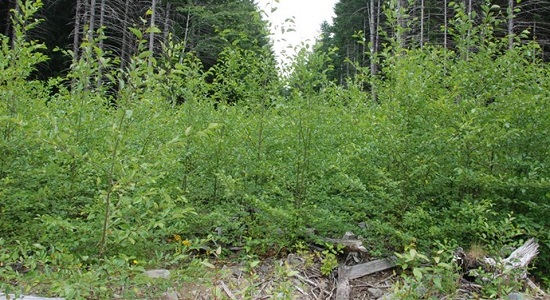
By July 2017, cover by fast-growing alders is obvious. None of these trees were planted—they grew naturally after the habitat was prepared using the rough and loose method that leads directly to their regeneration.

In case you missed it, here is the Fall 2018 Newsletter from SER-WC, with an introduction below from Board Chair Darcy Henderson.
Hello my fellow SER-WC members. This fall has been quite unusual, with a colder than normal September and then a warm and sunny October, and I suspect that has affected many of the projects on which you are working.
After spending most of my life in the Prairies and being accustomed to fall as the harvest time, I’m now learning in BC that fall is focused on the salmon runs. In both cases, people reap the gifts nature provides to us, in preparation for the winter ahead. The red bodies of sockeye salmon swimming upstream are the same striking red colours of Prairie sunsets during fall harvests. That beauty also reminds me why it is important to protect and restore our soils for carbon sequestration benefits and food productivity. Similarly, protecting and restoring these salmon streams and populations is essential for everyone, and has been for Indigenous peoples here for millennia, as a means to connect with the wonders of the world around us. How lucky we are to live in Western Canada.
In September, we had an amazing AGM at the Water Centre in Calgary, Alberta. The City of Calgary was gracious hosts and provided speakers who profiled restoration projects in the cottonwood forests and upland fescue grasslands along the Bow River. Speakers included entrepreneurs, university researchers, engineering consultants and biologists, while students from Lakeland College made the trek down from Vermillion, Alberta.
We are always seeking opportunities to host events that promote ecological restoration and connect our members with new ideas and information. If you’d like an event in your region, please contact us at restorewc@gmail.com, or via Facebook or Twitter.
Regards,
Darcy Henderson
Chair, SER-WC